

In the contemporary global economy, railways are no longer merely a means of transporting passengers or goods. They have become a strategic infrastructure that directly shapes national competitiveness, restructures supply chains, and reinforces economic sovereignty. This article adopts an analytical perspective to examine the functional transformation of railways under economic globalization, through a comparative approach between the Chinese model—based on the concept of “land-based sovereignty”—and the Algerian railway strategy, particularly the Oran–Gara Djebilet line. The analysis concludes that this project goes beyond a logistical option, laying the foundations for a geo-economic vision aimed at linking Africa’s hinterland to the Mediterranean and positioning Algeria as a strategic hub in intercontinental trade
The transport infrastructure sector is undergoing profound changes in both its role and function within the global economy. As competition among states intensifies, production capacity alone is no longer sufficient; the speed and efficiency of goods transportation have become decisive factors in achieving economic advantage. In this context, railways emerge as one of the most effective tools for connecting economic spaces, due to their reliability, regularity, and relatively lower costs compared to other modes of transport
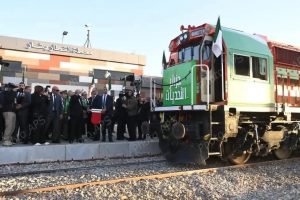
Railways and Supply Chains in the Modern Economy
: Railways constitute the backbone of modern supply chains, as they enable
The connection of industrial zones with sources of raw materials and final markets.
The reduction of logistical timeframes, directly impacting production costs.
As such, railway networks have become a key indicator of a country’s readiness to integrate into the global economy
The Chinese Model: Land-Based Sovereignty and the Reorientation of Global Trade
China offers an advanced model in leveraging railways as an instrument of economic influence. With a national network exceeding 162,000 kilometers—around 48,000 kilometers of which are high-speed—China has succeeded in connecting its internal markets while extending its railway corridors toward Central Asia and Europe within the framework of the Belt and Road Initiative
The Chinese vision prioritizes rail-based land transport for continental connectivity due to its ability to
Shorten shipping times compared to maritime transport.
Bypass geopolitical bottlenecks associated with major sea lanes.
Ensure greater sovereignty over trade flows.

Algeria’s Railway Strategy: Toward Linking the Industrial North with a Resource-Rich South
Within the African context, Algeria has adopted an ambitious strategy to revitalize its railway sector by expanding the national network from approximately 4,700 kilometers to 15,000 kilometers by 2030. This approach goes beyond mere transport modernization and reflects a comprehensive geo- economic vision based on two complementary dimensions
Linking the industrialized northern regions with the resource-rich southern hinterland, ensuring a steady flow of raw materials toward processing and manufacturing zones
Transforming southern Algeria into a continental exchange platform connecting Africa’s interior to the Mediterranean basin

The Oran–Gara Djebilet Line: From Infrastructure Project to Geo-Economic
The Oran–Béchar–Tindouf–Gara Djebilet railway line, stretching approximately 2,000 kilometers, represents the cornerstone of this strategy. This corridor is not merely a route for transporting iron ore; rather, it functions as
A logistical artery aimed at breaking the isolation of West Africa
A “land port” linking landlocked countries to Mediterranean seaports
A mechanism for redirecting African trade flows northward, reducing exclusive dependence on Atlantic ports
The project also embodies advanced engineering solutions, crossing challenging Saharan terrain through major bridges and smart freight terminals, thereby enhancing supply chain efficiency
Rail Transport versus Maritime Transport: A Logistical Time Revolution
A comparison between traditional maritime transport and the Algerian rail-based corridor reveals a decisive time advantage
Maritime transport via Atlantic ports to Europe: between 23 and 40 days
Rail-based transport through Algeria to Mediterranean ports: between 6 and 10 days
This time difference—reaching up to 30 days—significantly reduces storage and insurance costs, accelerates capital turnover, and enhances the competitiveness of African products in global markets
Market Prospects and Continental Integration
This railway network targets a vast demographic market in West Africa, projected to exceed 470 million inhabitants by 2026. Connecting this population hub to the Mediterranean through Algeria implies
A redrawing of the regional trade map
The elevation of Algeria from a transit country to a global logistics hub
The strengthening of African integration in its practical economic dimension
Conclusion
Algeria’s strategic bet on railways—particularly the Oran–Gara Djebilet project—reflects a shift from traditional infrastructure logic to a paradigm of economic sovereignty. This project transcends national borders to establish a new model of African integration, transforming the Sahara from a geographical constraint into a strategic bridge linking the heart of Africa to global markets